Geocell for Road Construction: Solving Subgrade Instability and Cost Challenges
bilizing weak foundations and extending pavement service life. Roads built on soft clay, silt, or loose sand often suffer from rutting and settlement due to insufficient bearing capacity. By integrating advanced HDPE Geocell Systems from Geofantex, engineers can significantly improve structural integrity while reducing material waste.
Why Do Roads Fail Prematurely on Weak Subgrades?
Soft subgrades cannot effectively resist repeated traffic loads, which causes the base aggregate to move laterally and results in deformation over time. This instability accelerates pavement cracking and increases maintenance costs. Installing a geocell for road construction system forms a three-dimensional confinement structure that locks aggregate in place and distributes loads more evenly across the foundation. As explained in Road Stabilization Solutions, cellular confinement improves bearing capacity and minimizes differential settlement, making it especially effective for challenging soil conditions.

How Can Construction Costs Be Reduced Without Compromising Strength?
Increasing base thickness is a traditional response to weak soils, but this approach significantly raises aggregate and transportation expenses. Geocell systems improve structural efficiency by confining infill materials, which allows engineers to reduce overall base depth without sacrificing performance. According to Geosynthetics Applications, optimized reinforcement solutions help contractors lower raw material usage, shorten construction time, and reduce long-term maintenance costs.
Why Is Geocell More Effective Than Traditional Planar Reinforcement?
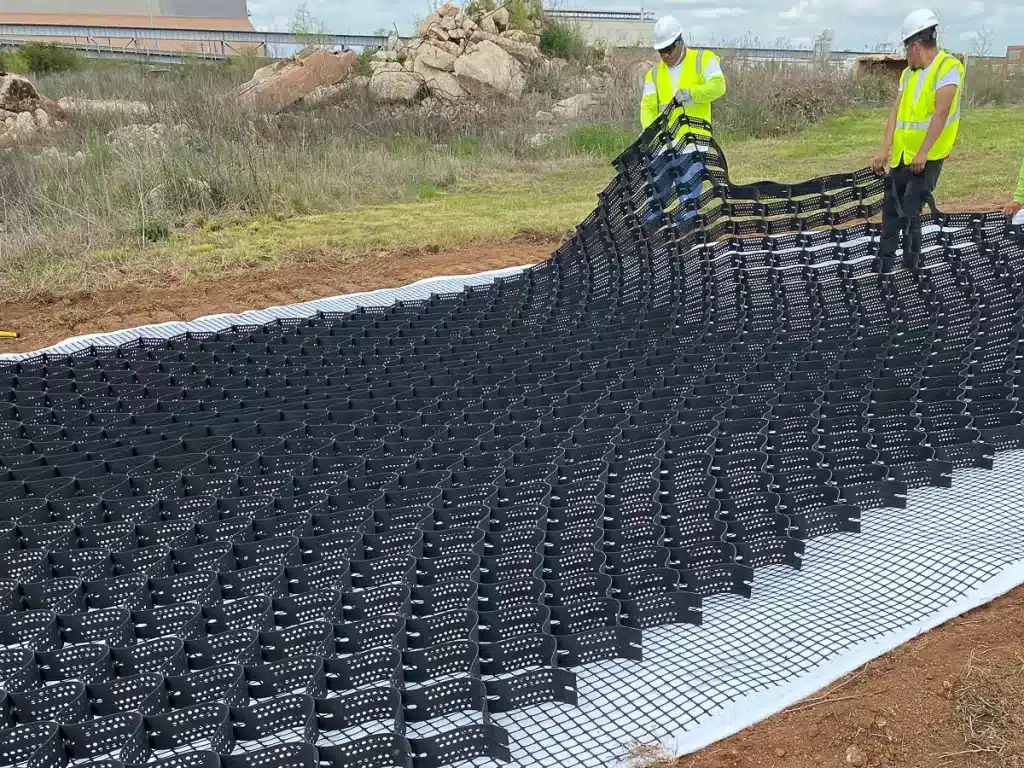
Planar reinforcement materials such as geogrids mainly provide tensile strength within a two-dimensional plane. While effective under moderate conditions, they may not fully prevent lateral spreading in extremely soft soils. In contrast, geocells create a three-dimensional honeycomb structure that confines aggregate from all directions. This multidirectional confinement enhances vertical load transfer and reduces surface deformation, making geocell for road construction a more reliable stabilization method in demanding environments.
Where Is Geocell Most Commonly Applied in Road Engineering Projects?
Geocell systems are widely applied in rural access roads, mining haul roads, temporary construction platforms, and parking areas where subgrade strength is limited. These projects require both durability and cost control. By adopting a geocell for road construction solution, project owners can achieve improved load-bearing performance, longer service life, and lower lifecycle costs, ensuring sustainable and efficient road infrastructure development.
Weak foundations and rising material costs continue to challenge road construction projects worldwide. By incorporating geocell technology into pavement design, engineers can effectively stabilize soft soils, optimize material usage, and extend pavement service life. This makes geocell systems a strategic and sustainable choice in geosynthetic road engineering solutions.


Comments
Post a Comment